Skip to content

Padel rules, simply

Six rules cover almost every point. Read them once, then play.

  1. Four players, two pairs

    Padel is doubles on a court with walls. You and your partner share one half of the court.

  2. Serve from waist height or below, across the court

    Bounce the ball behind the service line and hit it at or below your waist. It must land in the service box diagonally opposite. If it then hits the glass, the serve is still good. If it hits the mesh, it is a fault.

  3. Let the serve bounce

    The return of serve must bounce before you hit it. After that, you can volley.

  4. One bounce, then the walls are in play

    The ball may bounce once on your side. After that bounce it can hit the glass or the mesh and you can still play it. A second bounce is their point.

  5. Floor first

    Your shot must bounce on their side before it touches a wall or the mesh. If it hits their wall first, it is out.

  6. Lines are in. Don't touch the net

    A ball that touches the line is in. If you touch the net or the posts with your body, clothes or racket during a point, you lose the point.

In or out?

Decide, then open the answer.

The ball bounces in court, then hits the glass or the mesh

In. Keep playing. After a bounce, the walls are in play.

The ball bounces twice on your side

Out. Their point.

Your shot hits their wall or mesh before bouncing on the floor

Out. Floor first, always.

You hit the ball before it crosses the net to your side

Out. Wait for it to come over.

The serve bounces in the box, then hits the glass

Good serve. Glass after the bounce is fine on a serve.

The serve bounces in the box, then hits the mesh before a second bounce

Fault. On a serve, mesh after the bounce is a fault.

You hit the ball off your own back glass and it goes over the net and bounces in their court

In. Legal, and it surprises a lot of first-timers.

The court and what's in play

A padel court is 10 × 20 m, enclosed by walls and mesh. A net splits it in half.

  • Net. 88 cm at the centre and 92 cm at the posts. That is a touch lower than tennis.

Court measurements

  • Service boxes. Two on each half, marked by a line 6.95 m from the net, with a centre line between them. A serve lands in a box. You do not stand in it.
  • Back walls. 3 m of wall, usually glass here, plus 1 m of mesh. That is 4 m in total.
  • Side walls. FIP allows two layouts. One is stepped: 3 m high for 2 m, then 2 m high for the next 2 m from each back wall, with mesh in the middle. The other is a continuous 3 m wall for 4 m from each back wall, with mesh completing the cage.

After a legal bounce, the glass and the mesh are in play. The walls keep the ball alive, which is why a padel rally feels nothing like tennis.

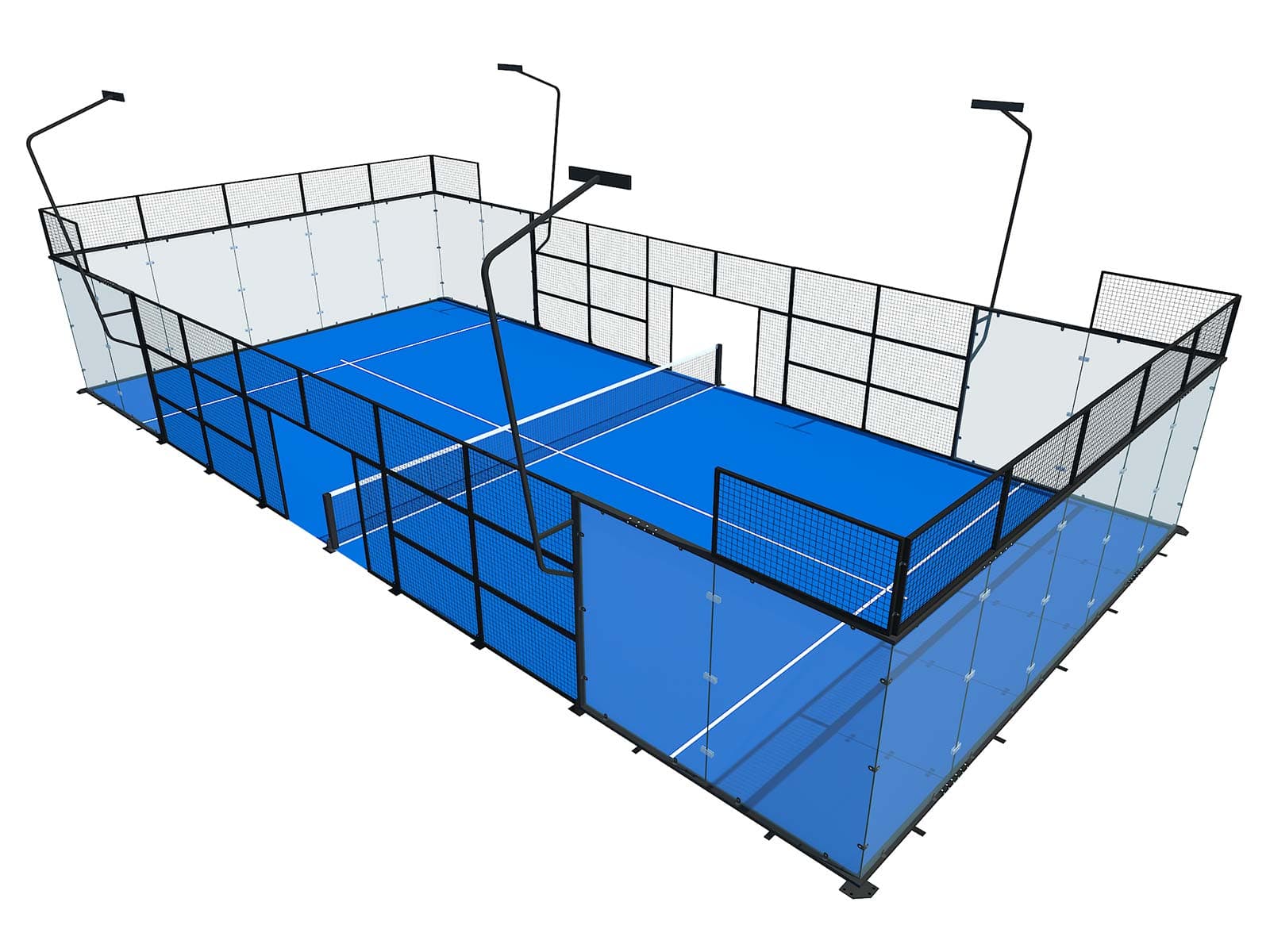
3D isometric render of a standard enclosed padel court, with walls and mesh, a net across the centre, and a blue playing surface with the service lines marked.
A standard FIP padel court, 10 × 20 m. The ends are a 3 m wall, usually glass here, plus 1 m of mesh.

If you already play tennis

Padel compared with tennis
AspectPadelTennis
PlayersDoubles in standard club playSingles or doubles
WallsIn play after the bounceOut of bounds
ServeAt or below waist heightOverhead
Court10 × 20 m, enclosedBigger, open
What winsPlacement. Power comes back off the glassPower decides more often

The biggest change from tennis: stop hitting hard and start using the walls.

How scoring works

Points run 15, 30, 40, game. The structure is the same as tennis. The walls change the rally, not the scoreboard.

Points won and what you call
Points wonYou call
0Love
115
230
340
4Game, if that pair is ahead

When both pairs have won three points, the score is 40–40, called deuce. What happens next depends on the deuce format.

A set goes to the first pair with six games and a two-game lead, such as 6–4, or 7–5 after 5–5. At 6–6 you play a tie-break. A full competition match is often best of three sets. Ask which format you are playing before the first serve.

At 40–40, three options

An organiser picks one for a competition. In a friendly, agree before the first serve. Ask: “Advantage, golden point, or star point?”

  • Advantage. The next point after deuce gives advantage. Win the one after that and you win the game. Lose it and it goes back to deuce.
  • Golden point. One deciding point at 40–40. The winner takes the game.
  • Star point. You get up to two advantage rounds. At the third deuce, one deciding point, the star point, wins the game.
Keep the score

Tap who won each point. Pick how you play 40–40.

0–0

Games 0–0. Sets 0–0.
UsThem
Games00
Sets00

More scoring detail

Deciding point. The receiving pair chooses the left or right side. Receivers cannot swap positions for that point. In mixed doubles, the receiver must be the same sex as the server.

Tie-break. Points count 0, 1, 2, 3 instead of 15, 30, 40. The first pair to 7 points, winning by 2, takes the set 7–6. The player due to serve starts with one point from the right. The other pair then serves two points, first from the left. After that each pair serves two points in turn. Change ends every six points.

Who serves. Pairs alternate serving each game, and partners take turns within a pair. Decide who serves first before the set. Change ends after games 1, 3, 5, 7 and so on.

Other formats. Some events agree another format in advance. A mini set is first to four games, winning by two, with a tie-break at 4–4. At one set all, a match tie-break to 7 or a super tie-break to 10, each won by 2, replaces the third set.

At Irish clubs. There is no separate Irish scoring system. Clubs follow FIP, and the deuce option varies. As of 5 October 2026, the Irish Padel Tour uses golden point. In Northern Ireland, LTA grades 1 and 2 use star point, mandatory from 1 January 2026, as of the LTA organiser guide of 12 May 2026. Grades 3 to 5 may use it.

What changed in the 2026 rules

The new rules, in four lines

  • At 40–40 there are three official ways to play: advantage, golden point and the new star point. Agree which one before you start.
  • Star point is used from 2026 on Premier Padel, the CUPRA FIP Tour, FIP Promises and FIP Beyond.
  • Serving: one foot stays behind the service line, the other may be in front, and neither may touch the line.
  • The ball must not cross the service line or the centre line before you hit it. If it does, it is a fault.

The serve in detail

The foot behind the line stays between the imaginary centre line and the side wall until you hit the ball. At least one foot is on the ground at contact.

The 2021 Rome rulebook required both feet behind the line. The 2026 book does not.

Watch a high bounce: if it drifts over either line before you hit it, it is a fault, even if the serve lands in the right box.

Video by Hello Padel — we curate, the creator owns it. Watch on YouTube