
beginner · ~4 min read
The court & what's in play
Doubles on a glass-walled cage — what's in, what's out, and the one-bounce rhythm.
Last reviewed
In one minute
Padel is doubles on a glass-walled cage. The ball must bounce on the floor once before you hit it — even on the return of serve. After that bounce, the walls and mesh are in play, not out. One bounce, return, repeat. That's the whole rhythm.
Quick specs
- Format: doubles — 2 vs 2
- Court: 10 × 20 m, fully enclosed by glass and mesh
- Net: 88 cm at the centre, 92 cm at the posts (a touch lower than tennis)
- Serve: underhand, diagonal, let it bounce
- Golden rule: one bounce — then the walls are your friends
The court
A net splits the court in half. Each half has two service boxes marked by a line 6.95 m from the net, with a centre line between them. The whole playing area sits inside a glass-and-mesh cage: solid glass on the back walls and on the side walls near the back — typically the first 2 m on the most common layout (FIP also permits a 4 m continuous side-glass variant) — with metal mesh on the mid side panels. After a legal bounce, glass and mesh are all in play — the walls keep the ball alive, which is why a padel rally feels nothing like tennis.
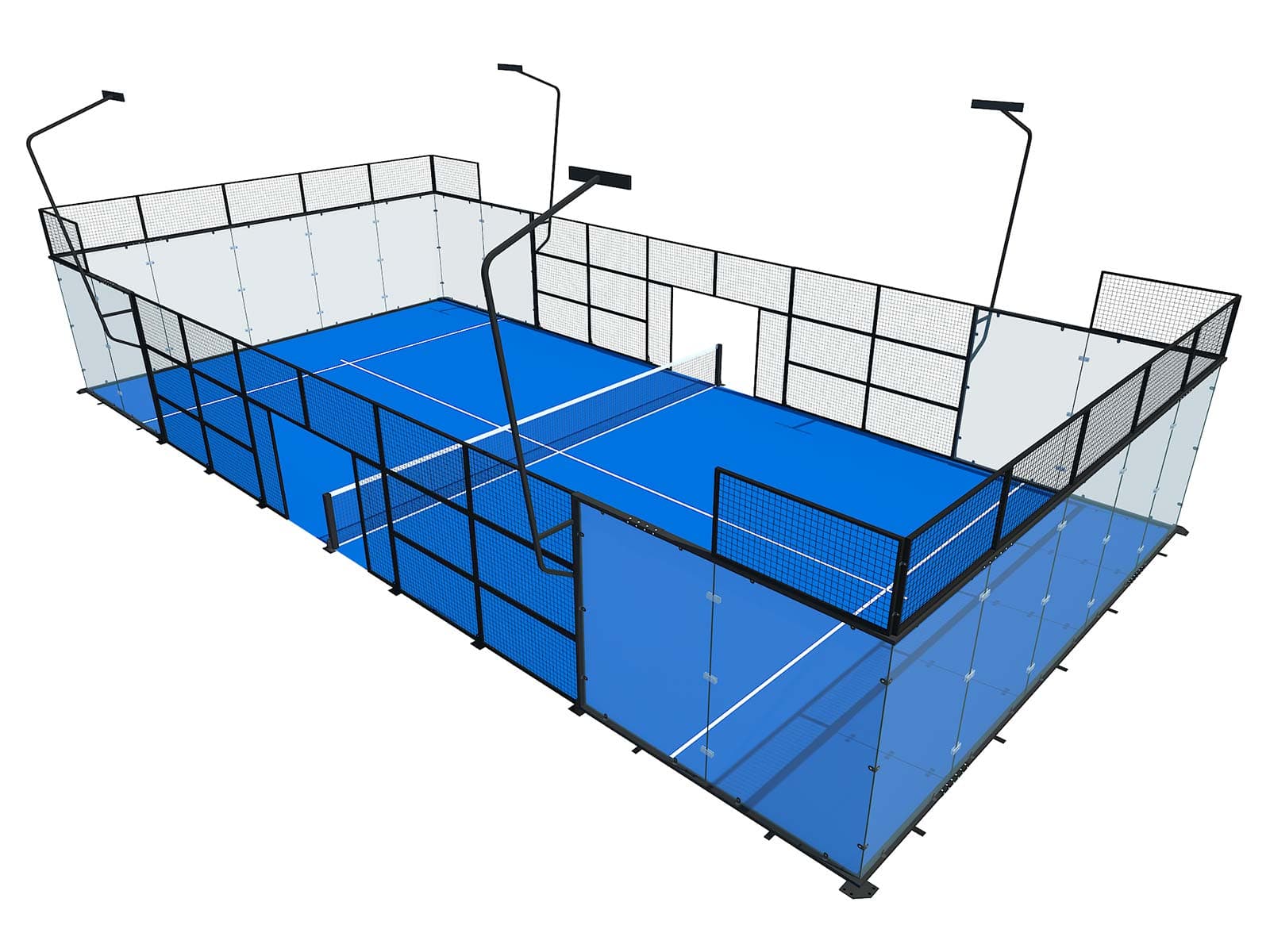
At Irish clubs you'll almost always play doubles on the full 10 × 20 m court. Singles courts exist in the rulebook but are rare in club play.
Padel vs tennis (the short version)
If you're coming from tennis — most Irish players are — this is the mental shift that matters.
| Padel | Tennis | |
|---|---|---|
| Players | Doubles (standard club play) | Singles or doubles |
| Walls | In play after the bounce | Out of bounds |
| Serve | Underhand, below the waist | Overhead |
| Court | 10 × 20 m, enclosed | Bigger, open |
| What wins | Placement — power comes back off the glass | Power decides more often |
The single biggest change: stop hitting hard and start using the walls.
The rules you actually need
- Always four of you. Doubles. You're a pair — call the ball, don't both chase it. The server starts; the receiver stands cross-court.
- Floor first, then walls. The ball must touch the ground before it hits a wall or the mesh. After that bounce, glass and mesh keep it live.
- One bounce. Two bounces on your side = their point. That includes the serve — no volleying it back.
- Lines are in. Any part of the ball touching the line is good.
- Serve diagonal and underhand. Bounce it in your box, hit at or below waist height into the cross-court box. If it bounces in the box then hits the glass, it's still a good serve.
- Don't touch the net. Body, clothes or racket on the net or posts during a live point = their point.
In or out? Quick reference
| Situation | Result |
|---|---|
| Bounces in court, then hits glass or mesh | In — keep playing |
| Bounces twice on your side | Out — their point |
| Hits wall or mesh without bouncing on the floor first | Out |
| Hits opponent's wall/fence before bouncing in their court | Out |
| You hit before the ball crosses the net to your side | Out |
| Serve bounces in box, then hits glass | Good serve |
| Serve bounces in box, then hits mesh before a second bounce | Fault |
You can also hit off your own back or side glass and send the ball over the net — as long as it eventually bounces in the opponent's court. It's legal, and it surprises a lot of first-timers.
Common mix-ups
- "If it hits the wall, it's out." Not after a floor bounce — that's normal padel.
- "It's mini-tennis — singles and power." Doubles, walls, placement. Hard hits often come straight back off the glass.
- "The mesh is the same as the glass." On serve, mesh after the bounce is a fault. In a rally, mesh after a bounce is in play.
- "I'll volley the serve back." Wait for the bounce in the service box.
Try this next time
- Wall watch — In a friendly rally, call "floor" when it bounces and "glass" when it hits the back wall. Builds the rhythm fast.
- Serve box drill — Serve 10 balls cross-court. Count how many bounce in the box before touching anything else.
- Two-bounce test — In a practice point, let one doubtful ball bounce twice. You'll feel how quickly the second bounce ends the point.
What's next
Scoring works like tennis — see the scoring guide. For now, focus on keeping the ball in play and letting the walls help you instead of fighting them.